Baca dalam Bahasa Melayu: Cara Kira Gaji OT di Malaysia
Overtime is one of the most common causes of payroll disputes in Malaysia. The rules come from the Employment Act 1955, and the rate depends on when the extra hours were worked: a normal day, a rest day or a public holiday. Here is how to work it out.
Who is entitled to overtime pay?
Under the Employment Act, statutory overtime applies to:
- employees earning RM4,000 a month or less, and
- manual workers and those who supervise them, whatever their salary.
For employees earning more, overtime depends on their employment contract or company policy.
Working hours and limits
- Normal hours: up to 8 hours a day and 45 hours a week.
- Overtime: up to 104 hours a month.
- Total hours in a day, including overtime, are generally limited to 12.
Step 1: work out the hourly rate
- Daily rate (ordinary rate of pay) = monthly salary ÷ 26
- Hourly rate = daily rate ÷ normal hours per day
Example: salary RM2,600, 8-hour day. Daily rate = RM2,600 ÷ 26 = RM100. Hourly rate = RM100 ÷ 8 = RM12.50.
Step 2: apply the right rate
| When the work is done | Rate | Example (hourly rate RM12.50) |
|---|---|---|
| Overtime on a normal working day | 1.5 × hourly rate | RM18.75 an hour |
| Rest day, within normal hours | Half a day’s pay (up to half the normal hours) or a full day’s pay (more than half) | RM50 or RM100 |
| Rest day, beyond normal hours | 2 × hourly rate | RM25.00 an hour |
| Public holiday, within normal hours | 2 days’ pay, on top of the holiday pay | RM200 |
| Public holiday, beyond normal hours | 3 × hourly rate | RM37.50 an hour |
Example: an employee on RM2,600 works 3 hours of overtime on a Tuesday. Overtime pay = 3 × RM18.75 = RM56.25.
These rates are for monthly-paid staff, following sections 60(3) and 60D(3) of the Employment Act. Daily-rated and piece-rated staff are paid more for rest-day work. If in doubt, check with the Labour Department (JTKSM).
Common overtime mistakes
- Dividing the salary by the number of days in the month instead of 26.
- Paying overtime on a flat rate for every day, ignoring rest-day and public-holiday rates.
- Forgetting that the RM4,000 threshold decides who qualifies.
- Going over the 104-hour monthly limit.
- Relying on handwritten timesheets. Overtime disputes usually come down to whose record is right.
Accurate overtime starts with accurate attendance
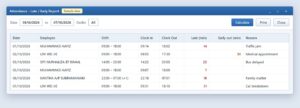
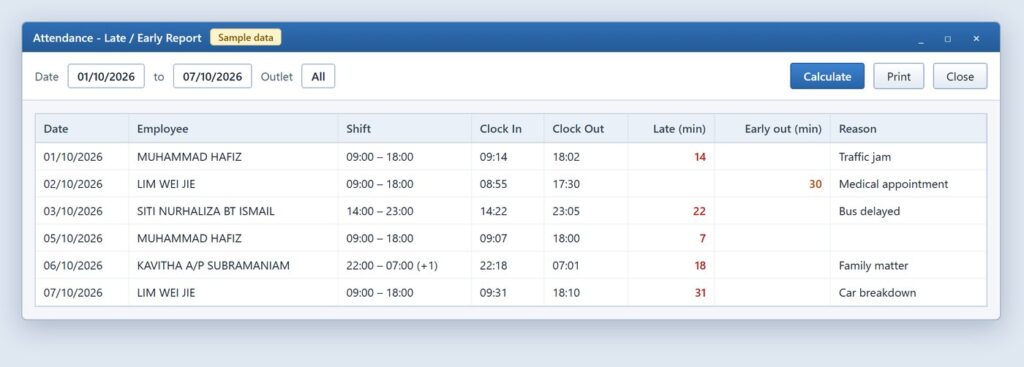
The Synergy attendance system records clock-ins by face recognition, ID card or fingerprint, plans shifts with a duty roster and works out actual hours, including night shifts, so you have a reliable record of the extra hours. The overtime hours are then entered in Synergy payroll, which includes the overtime pay in SOCSO, EIS and PCB and shows it on the payslip. Prefer Malay? Read about sistem kehadiran Synergy.
Frequently asked questions
What is the overtime rate in Malaysia?
1.5 times the hourly rate on a normal working day, 2 times on a rest day and 3 times on a public holiday, for hours beyond normal working hours.
How do I calculate the hourly rate?
Divide the monthly salary by 26 to get the daily rate, then divide by the normal hours per day.
Who is entitled to overtime?
Employees earning RM4,000 a month or less, and manual workers whatever their salary.
What is the maximum overtime a month?
104 hours.
Is overtime included in EPF?
No. Overtime pay is not counted as wages for EPF, but it is included for SOCSO, EIS and PCB.
Keep a clean record of every hour worked. Book a demo of the Synergy attendance system.